
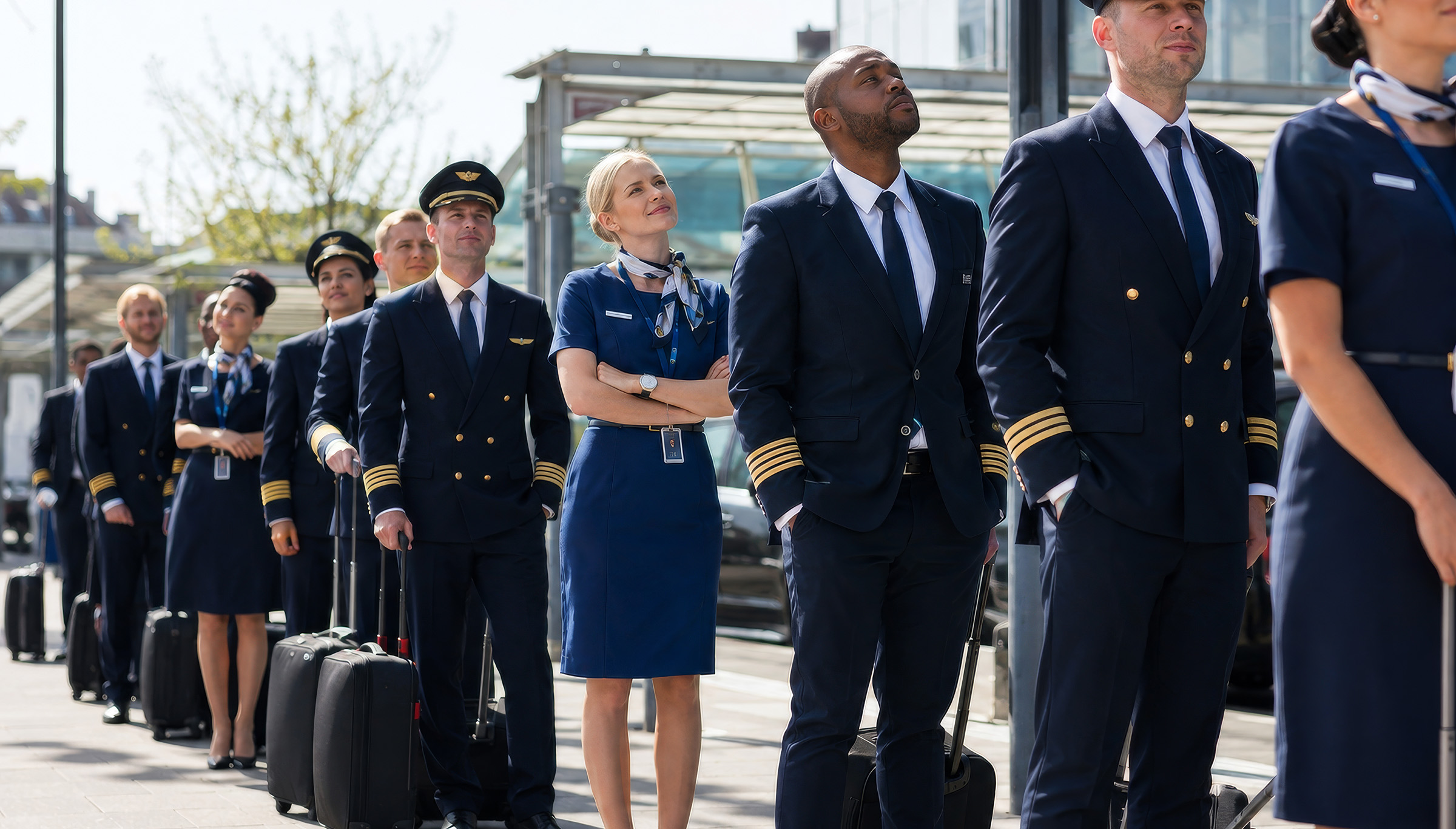
Pilots, aircraft technicians and cabin crew remain in strong long-term demand. But the jobs aviation needs most are not always the jobs beginners can immediately fill.
Information checked: August 17, 2026
Aviation has a strange employment problem.
The industry says it needs huge numbers of new people.
Boeing’s 2026 Pilot and Technician Outlook estimates that commercial aviation will require approximately 674,000 new pilots, 728,000 maintenance technicians and 1.023 million cabin crew members through 2045. Airbus publishes a similarly strong long-term demand outlook.
And yet many newly qualified candidates still struggle to get their first real opportunity.
Why?
Because aviation does not simply have a people shortage.
It often has an experience shortage.
The Aviation Experience Paradox
An airline may need pilots but prefer candidates with multi-crew experience.
An MRO may urgently need B1/B2 engineers with recent certifying experience, while newly trained mechanics are still trying to get the practical experience that moves them toward those roles.
An airline may need thousands of cabin crew over several years while receiving huge numbers of applications for every entry-level recruitment campaign.
So two things can be true at the same time:
Aviation can have a long-term workforce shortage.
And:
Getting the first aviation job can still be highly competitive.
The problem is that the industry needs experienced professionals, but someone has to give beginners the opportunity that creates that experience.
Where AI May Change the Equation
A 2026 Stanford study found that younger workers in occupations highly exposed to AI were seeing weaker employment growth than more experienced workers.
Importantly, the difference appeared mainly through lower hiring rather than higher firing rates.
That does not prove the same thing is happening in aviation.
There is currently no strong aviation-specific evidence showing that AI is causing a collapse in junior pilot, cabin crew or maintenance hiring.
But the mechanism is worth watching.
AI disruption does not have to look like:
500 employees being replaced.
It can look like:
a company deciding it needs fewer junior people because experienced employees can handle more routine work with better technology.
Nobody is fired.
The entry point simply becomes narrower.
Aviation Is Different From Many Other Industries
Pilots, engineers and cabin crew perform highly regulated, safety-critical and often physical work.
A technician still has to inspect and maintain an aircraft.
A pilot still needs judgement, communication, situational awareness and operational responsibility.
Cabin crew remain responsible for safety, emergency procedures, evacuation and passenger management.
That makes direct replacement much harder than in occupations built mainly around routine digital information processing.
The more realistic change is likely to be:
technology handles more routine work while employers expect humans to provide more judgement.
For Pilots: The First Airline Seat Is Still the Bottleneck
Boeing forecasts approximately 674,000 new pilots through 2045.
But a newly qualified pilot may still face vacancies asking for:
- multi-crew experience;
- turbine time;
- hundreds of hours;
- hours on type;
- recent commercial experience.
This is the pilot version of the experience paradox.
The industry needs experienced pilots.
The low-hour pilot needs someone to provide the first opportunity that eventually creates that experience.
For early-career pilots, the priority should therefore be:
turn qualifications into meaningful operating experience as efficiently as possible.
The most useful first job is the one that improves:
- recency;
- commercial experience;
- decision-making;
- SOP discipline;
- CRM;
- future airline eligibility.
Another certificate does not always solve an experience problem.
For Engineers and Technicians: Demand Is High, but It Is Specific
Boeing currently forecasts approximately 728,000 new maintenance technicians through 2045.
But employers rarely need just “an engineer.”
They may need:
B1.1 + B737NG/MAX + recent certifying experience
or
B2 + A320 family
or
an experienced aircraft mechanic with commercial-aircraft maintenance experience.
That is why a technician shortage can exist while newly trained mechanics still struggle to enter the industry.
AI may also change some maintenance workflows.
That does not remove the engineer.
It may reduce time spent on routine analysis while increasing the value of:
- troubleshooting;
- licensing;
- aircraft experience;
- technical judgement;
- responsibility;
- understanding whether automated output actually makes sense.
For a new mechanic or technician, the strongest first job is usually one that creates real aircraft experience and a clear progression route.
For Cabin Crew: Huge Demand Does Not Mean Easy Selection
Boeing forecasts more than one million new cabin crew members through 2045.
That is enormous demand.
But cabin crew recruitment can still be highly competitive because entry requirements are more accessible than for licensed engineers or commercial pilots.
Technology will continue to automate parts of the passenger journey.
Check-in.
Notifications.
Customer-service queries.
Retail.
Information delivery.
But cabin crew are not simply onboard service staff.
Their responsibilities include:
- safety;
- emergency response;
- evacuation;
- passenger conflict;
- security awareness;
- teamwork;
- communication under pressure.
For candidates, that means the strongest interview evidence increasingly comes from situations involving:
responsibility, difficult customers, teamwork, safety awareness and judgement.
Not simply:
“I enjoy travelling and meeting people.”
The 2.4 Million Worker Forecast Is Easy to Misread
The long-term workforce forecast does not mean:
- 2.4 million vacancies exist now;
- all roles are entry-level;
- every region has the same shortage;
- every licence is equally valuable;
- airlines will lower their standards;
- every qualified candidate will immediately be hired.
There is no single global aviation labour market.
Your real market depends on:
region + licence + experience + aircraft + work rights + employer requirements.
That is why someone can read about a global pilot or technician shortage and still send dozens of unsuccessful applications.
What Should Beginners Optimise For?
Across pilots, engineers and cabin crew, the same principle applies:
Get experience that becomes more valuable with time.
For a pilot, that means useful commercial flying.
For a mechanic, real aircraft maintenance experience.
For cabin crew, operational airline experience and real passenger situations.
When choosing an early-career opportunity, ask:
Will this role give me experience my next employer will recognise?
Will my responsibility increase?
Will I work with experienced professionals?
Will I be exposed to real operational decisions?
Is there a clear next step?
A famous employer with limited practical exposure is not always better than a smaller employer that gives you genuine responsibility.
Why Employers Should Care Too
This is not only a candidate problem.
If aviation companies reduce junior hiring because experienced employees become more productive, they may create a new shortage several years later.
A B1/B2 engineer does not appear with five years of aircraft experience overnight.
A Captain does not appear with thousands of hours.
A senior cabin crew member does not begin their career knowing how to manage difficult onboard situations.
Experienced professionals are created through years of work.
So employers need to ask:
If we hire fewer beginners today, who becomes experienced tomorrow?
Automation may improve short-term productivity.
But if it removes too many entry points, the industry could weaken its own future talent pipeline.
Mentoring May Become More Important, Not Less
Hiring juniors is only part of the answer.
They also need experienced people who have enough time to teach them.
Pilots learn from Captains and instructors.
Mechanics learn from licensed engineers.
New cabin crew learn from experienced crew and trainers.
If new technology simply allows senior employees to carry a heavier workload, mentoring can easily become the first thing that disappears.
That would be short-sighted.
The knowledge aviation most needs to preserve is often not written perfectly in a manual.
It comes from years of seeing what happens when the real situation does not look exactly like the training scenario.
Final Verdict
AI does not currently give us a reason to conclude that aviation will stop needing pilots, engineers, technicians or cabin crew.
The long-term forecasts suggest the opposite.
Boeing expects commercial aviation to require more than 2.4 million new pilots, maintenance technicians and cabin crew through 2045.
But that does not mean the first job becomes easy.
The bigger issue may be the gap between:
being qualified and being experienced enough to solve an employer’s immediate problem.
For candidates, the strategy is clear:
prioritise real experience, not just more certificates.
For employers, the warning is equally important:
today’s entry-level hires are tomorrow’s Captains, B1/B2 engineers and senior cabin crew.
Aviation may not have a shortage of people who want to enter the industry.
Its bigger challenge may be creating enough opportunities for beginners to become the experienced professionals it already knows it will need.